The Answer Up Front — As Concrete As Honesty Allows
At SynapSync, the path looks like this:
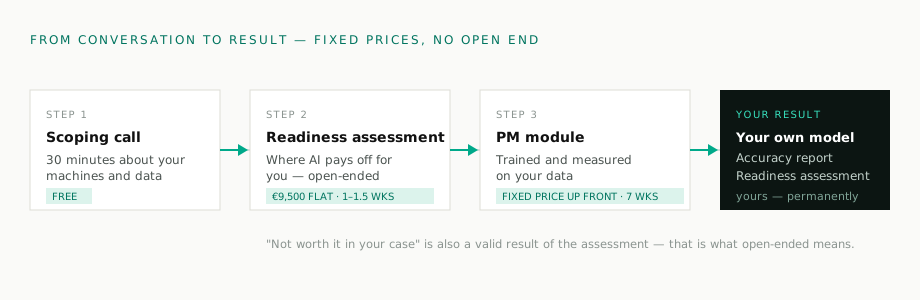
- Entry: the AI Readiness Assessment at a flat €9,500, 1–1.5 weeks. Result: where AI pays off in your production — and where it doesn't. Open-ended by design, and it says so in the quote.
- The Predictive Maintenance module: fixed price after scoping, 7 weeks. The price is fixed in writing after a short conversation about your equipment and data situation — before the start, not billed by effort. If it takes longer, that is our problem.
Why is there no flat rate for the module here? Because it would be a lie. The effort depends on factors that differ at every plant — and any vendor who quotes you a final price without looking at your equipment either has hidden follow-up costs or will re-quote the moment they see your shop floor.
What the Price Actually Depends On
Four factors drive the scoping — you can estimate them yourself in advance:
1. Your data situation. Does machine data already exist (PLC logs, MES, historian)? Then the most expensive element of many projects disappears: months of data collection. If not: our system's universal drift watchdog needs no historical data — it learns each signal's normal range from the first readings and delivers from week one. Machine-specific trained models are added once your data supports them.
2. Number and variety of machines. One machine with 300 signals is a different project than twelve machines of three different designs. Important for follow-up costs: in our architecture, another machine is a configuration file, not a new software project — which is why the second line costs considerably less than the first.
3. The connection. We connect directly to Beckhoff/TwinCAT and OPC-UA, with no new hardware and no changes to your control programme. Exotic legacy controllers cost effort — we tell you that in the scoping, not in the final invoice.
4. Existing sensors. We work first with what your machines already report. Retrofit sensors are the exception, not the hidden mandatory line item.
The Hidden Costs of the Other Models
When comparing offers, look closely at three common pricing models:
The subscription (cloud). Sounds cheap per month, never ends. After five years you have paid a multiple of a fixed price — and if you cancel, nothing remains. Plus the dependency: vendor gone, system gone.
The day rate. "Let's see what your data can do" at €1,800 a day is not a project, it is an open end. Without a named result, you carry all the risk.
The data collection project. Some approaches demand six to twelve months of sensor data before anything happens at all. Those are hidden costs in the form of time — and often the end of the project before it began.
Our model instead: fixed price before the start, fixed duration, a named result. And a perpetual license — licensed once, usable indefinitely, with no remote revocation by design.
What You Hold in Your Hands at the End
The Predictive Maintenance module does not end with a slide deck. It ends with three things:
- A trained model for your equipment — that you own. No rental, no cloud access that can be switched off.
- An accuracy report, measured on your data. What accuracy you can expect, we will not tell you in advance — and distrust anyone who does. It depends on your data, machines, and sensors. What we commit to: at the end, the measured figure for your own equipment is in the report. If it comes out poorly, that is what it says.
- A production-readiness assessment — whether and how continuous operation pays off.
When It Is NOT Worth It
The section missing from sales copy: there are situations where we advise against it.
- Your machines produce barely any data and retrofitting is out of proportion to the failure risk.
- Unplanned downtime costs you little — if a stop threatens neither delivery dates nor expensive equipment, early detection rarely pays.
- You expect an oracle. We do not sell predictions of which component fails when — we detect deviations early and explain them. That is worth a great deal, but it is a different thing.
This is exactly why the readiness assessment is open-ended: occasionally, part of its result is "not worth it here." That costs you €9,500 — and saves you a multiple.
The ROI Calculation You Can Fill In Yourself
We will not present you someone else's average ROI — figures from other plants are worthless for your decision. The calculation that matters has three lines, and you know every value yourself:
- What does one hour of unplanned downtime cost you at your most critical line (lost output, scrap, penalties, weekend callouts)?
- How many such hours did you have in the last twelve months?
- What share of them would early detection with several operating cycles of lead time have made plannable?
For context on line 3: on our reference installation, degradation signatures were detected 6–12 operating cycles before measurable mechanical change — enough lead time to schedule interventions instead of improvising them mid-failure. Across the 180-day evaluation period, there was zero unplanned downtime. A single installation, labeled as such — but it shows the order of magnitude that makes line 3 realistic.
The next step is not a purchase, it is a conversation: describe one machine that costs you money. We reply within 1–2 business days — including when the honest answer is "not worth it in your case."