The Concerns Are Justified — Not Backward
Ask a plant manager why there is no AI running on their shop floor yet, and you will rarely hear "we don't see the value." Far more often: "Our data does not go to the cloud."
That stance is often dismissed as hesitation. It is the opposite: a correct risk assessment. Process data from manufacturing is not a byproduct — it is the process knowledge. Cycle times, temperature profiles, scrap patterns, recipes: anyone who reads this data can reconstruct how you manufacture. For many suppliers, NDAs with their own customers prohibit passing such data on anyway — regardless of how secure the cloud provider claims to be.
The Three Real Problems With Cloud AI in Production
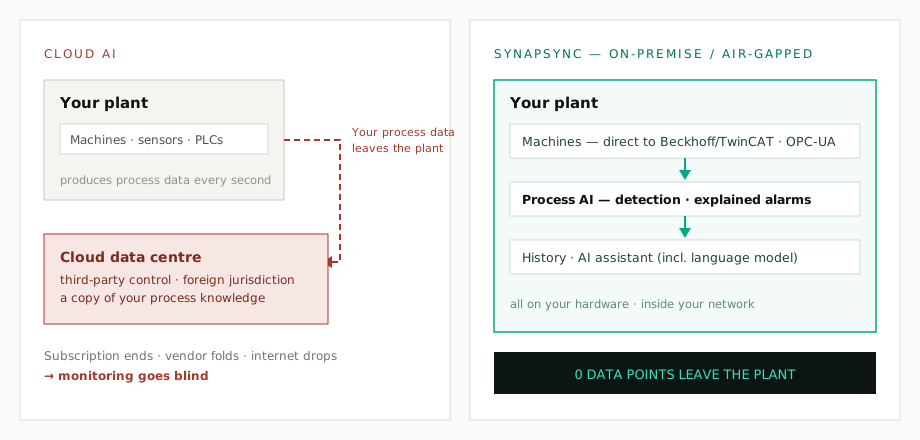
1. Your data is your process knowledge. Every cloud processing step means a copy of your manufacturing know-how exists outside your building, under someone else's control, in someone else's jurisdiction. Encryption and certificates don't make that problem disappear — only data that never leaves the site does.
2. Dependency is an operational risk. A cloud AI system stops working when the subscription ends, the vendor folds, or the internet connection drops. Condition monitoring that goes blind during an internet outage is not monitoring for critical processes — it is one more dependency.
3. Obligations decide, too. Automotive suppliers under customer NDAs, critical infrastructure operators, businesses with defence exposure: for many environments, external data processing is not merely undesirable — it is simply not permitted.
What "Without the Cloud" Actually Means
Two terms that often get blurred:
On-premise means the software runs on hardware in your building, inside your network. An internet connection may exist — the processing does not need it.
Air-gapped means the system runs on a physically separated network with no outside connection at all. That is the operating mode for environments where connectivity itself is a risk.
At SynapSync, air-gap is the delivery state, not a special configuration. On the reference installation, detection, the failure history, and the AI assistant — including the language model — run entirely on customer hardware. Not a single reading leaves the plant. The system connects directly to the existing machine controllers (Beckhoff/TwinCAT, OPC-UA), with no new hardware and no changes to the control programme.
"But Isn't AI Weak Without the Cloud?"
That is the most common objection — and it comes from a world where AI means giant language models in data centres. For monitoring production processes, it does not hold.
The reference installation reads 360 signals from an industrial line and assesses the entire machine every second — on embedded hardware at the site, with no GPU cluster, at a classification latency under 40 milliseconds. Across the 180-day evaluation period: zero unplanned downtime. These figures come from a single, real production installation — not an extrapolation.
The reason this works: anomaly detection on machine signals is a task that benefits from proximity to the machine, not distance. The system needs to learn your line — not the internet.
What It Costs and How to Start
The entry point is deliberately small: the AI Readiness Assessment costs a flat €9,500, takes 1–1.5 weeks, and answers where AI actually pays off in your production — with an open outcome. From there, fixed-price modules follow as needed, each with a fixed duration and a named result, all fully on-premise.
Two questions that always come up at this point:
"How do updates work without internet?" Updates are applied as a package — included for three years as standard, extendable. The system needs no standing connection for it.
"And if SynapSync is gone tomorrow?" Then your system keeps running. Perpetual license, no activation servers, no remote revocation by design. That is not goodwill — it is architecture.
The Honest Conclusion
Not every plant needs AI, and not every task justifies it. But that decision should be allowed to fail on the merits — not on the justified refusal to send process data out of the building. AI without the cloud is not a compromise with the handbrake on. For monitoring production equipment, it is the more natural architecture.
Want to know whether this works for your equipment? Describe one machine or one problem — that is enough for a first conversation. We reply within 1–2 business days.