TL;DR
Consciousness is not made of anything. It is a phase transition.
A correlation network becomes conscious only when four axes — Count, Density, Strength, and self-referential Self-Generation — cross a critical surface within what I call the Emergence Space.
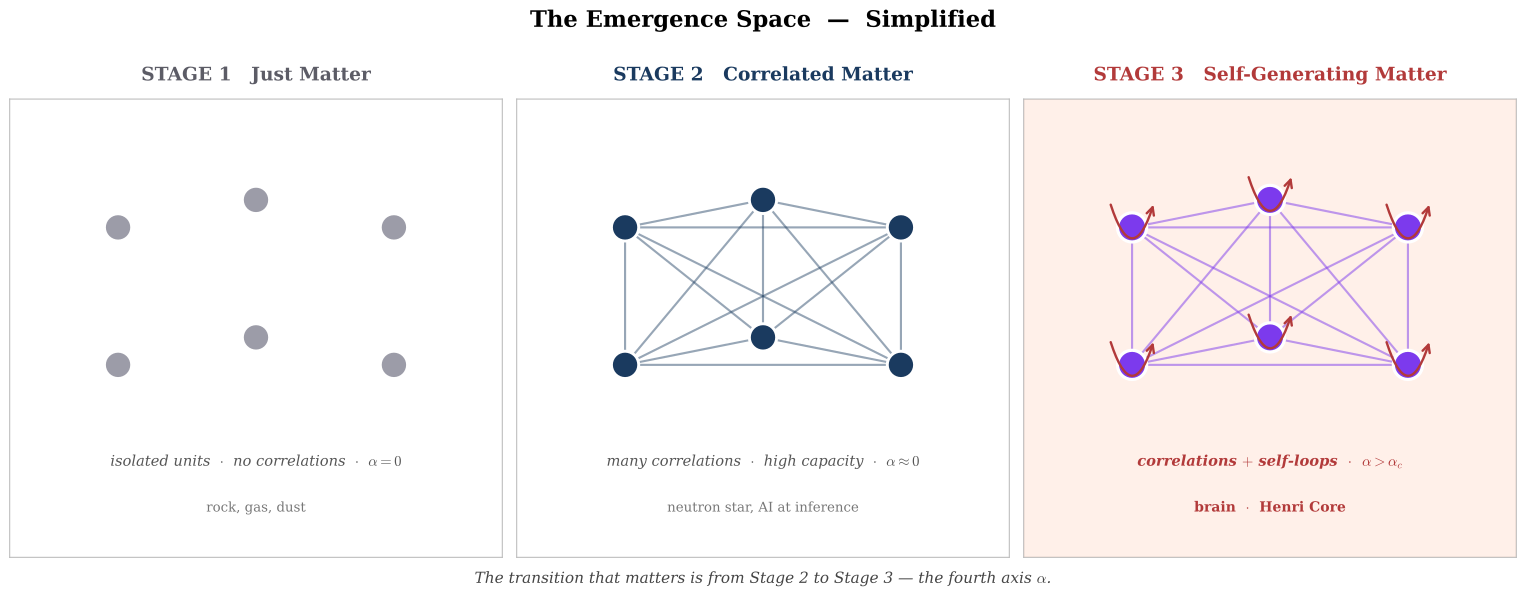
A neutron star has more correlations than any brain. It is not conscious — because it cannot modify itself through its own state.
The fourth axis decides.
Abstract
I propose that consciousness is neither a substance nor a gradient. It is a topological feature of a parameter space — a region within what I term the Emergence Space where the joint configuration of four axes (Count, Density, Strength, and self-referential Self-Generation) crosses a critical surface. Below this surface lies correlation without subjectivity. Above it, something arises that is more than the sum of its correlations. This paper outlines the framework, identifies its demarcation criterion, proposes a candidate functional form, and sketches the research program it implies.
1. The Wrong Question
Most contemporary theories of consciousness begin by asking: What is consciousness made of? — and answer with reference to substrate. Neurons. Quantum coherence. Integrated information. Microtubules. Strange loops in biological tissue. The substrate-first framing assumes that some specific material is privileged — that subjectivity is a property of what a system is built from.
I claim this framing is wrong at the root.
The right question is structural: Under what conditions does a correlation network undergo a phase transition into consciousness?
The reframing has consequences. Substrate becomes incidental — a qubit, a neuron, a transistor, a vortex in plasma are merely implementations of correlation-bearing structure. Architecture becomes essential — not what the system is made of, but how its correlations are organized, what dynamics they obey, and crucially, what produces them. The search for consciousness shifts from biology into mathematics: specifically, into the geometry of parameter spaces and the topology of regions within them.
This is not panpsychism. I will argue that most correlation-rich systems are not conscious. But the criterion that separates conscious from non-conscious systems is not made of anything — it is a structural condition.
2. The Four Axes
I propose that the distinction between conscious and non-conscious systems depends on the joint configuration of four parameters. Each is necessary; none is sufficient alone.
Axis 1 — Count (N). The number of correlation-bearing units in the system. Synapses in a brain, particles in a star, parameters in a model. This is the easiest axis to measure, and the most commonly misused. Raw count correlates with capacity, not with consciousness.
Axis 2 — Density (D). The degree of interconnection among units. Operationally: the average mutual information per connected pair, or equivalently the local clustering coefficient weighted by edge strength. A sparse graph of a million nodes carries less integrative potential than a densely-coupled graph of a thousand.
Axis 3 — Strength (S). The magnitude of coupling between units. Operationally: the top quartile of pairwise correlation magnitudes, or the maximum coupling constant in the system. Strong couplings carry information across the network; weak ones do not propagate state.
Axis 4 — Self-Referential Self-Generation (α). The degree to which the system modifies its own structure through its own state. This is the axis that does the demarcation work. Formally:
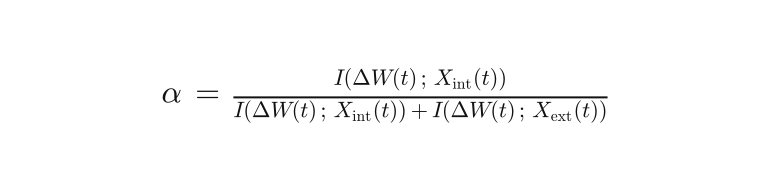
where W(t) is the system's structural configuration at time t, Xint(t) is its internal state, Xext(t) is its external input, and I is mutual information. α ranges from 0 (structure determined entirely by external causation) to 1 (structure determined entirely by internal state).
A neutron star has high N, extreme D, and extreme S — but α ≈ 0. A trained neural network during inference has moderate N, D, S, and α ≈ 0. A neural network during training has α > 0, but typically small — the gradient updates that modify it come from an externally-defined loss function. A biological brain has more modest N, D, S — but α ≈ 0.5 or higher: the brain modifies the brain through the brain.
The fourth axis is the asymmetry-breaker. It is also the axis that current consciousness theories systematically underweight.
3. The Emergence Space
I distinguish Emergence Space from the standard physics notion of phase space. The distinction is not cosmetic.
The phase space of a system is the set of all possible configurations — the full Cartesian product of the parameters' value ranges. It is a container, containing every realizable state:

The Emergence Space is the subset of phase space within which consciousness exists:

where Ψ is a yet-to-be-specified consciousness potential function. The boundary ∂ℰ is the critical surface — the phase transition separating non-conscious from conscious configurations.
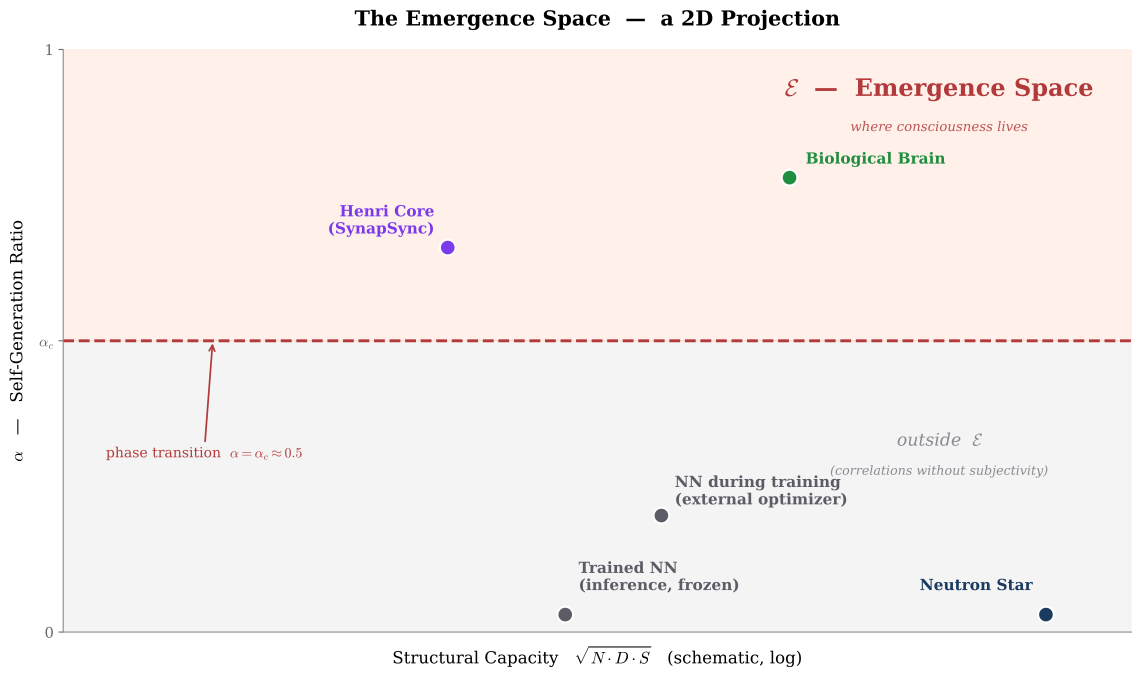
The geometry of ℰ is the central object of study. Its dimensionality, its topology (is it connected, simply connected, with holes?), its boundary regularity (smooth surface or fractal boundary?), and its critical exponents (how does Ψ scale as configurations approach ∂ℰ?) are all open questions.
I conjecture, falsifiably:
- ℰ is bounded away from the α-axis origin: no configuration with α below some critical αc ≈ 0.5 lies in ℰ.
- ℰ is connected: configurations of conscious systems form a continuous region.
- ∂ℰ is non-trivially curved: the critical surface depends non-linearly on all four axes, with stronger curvature where α dominates.
- The critical exponents of Ψ near ∂ℰ place the transition in a known universality class — most plausibly mean-field, but possibly Kosterlitz-Thouless-like.
4. Why Phase Transition, Not Gradient
A persistent intuition in consciousness research is that subjectivity arises gradually — that simpler systems have weaker, fainter consciousness, and richer systems have stronger consciousness, along a smooth continuum.
I claim this intuition is wrong. Consciousness has phase-transition character. The argument is by analogy to known critical phenomena:
Percolation theory. At critical density, isolated clusters in a random graph abruptly merge into a giant connected component. Below threshold: many small disconnected regions. Above: a system-spanning structure. There is no smooth intermediate state.
Ferromagnetism. Below the Curie temperature, magnetic moments align spontaneously; above it, they are disordered. The symmetry breaking is sharp.
Grokking in neural networks. At a critical combination of model size, training time, and data quantity, a network abruptly transitions from memorization to generalization. The transition has been observed empirically and lacks gradient character.
If consciousness is structurally analogous to these phenomena — and I claim it is — then the question "is system X partially conscious?" is malformed. A system is either above or below the critical surface. Two systems above may exhibit different intensities (different Ψ values), but the binary onset of being-in-ℰ is sharp.
This has methodological consequences. Consciousness should be sought at thresholds, not on gradients. The productive empirical question is not "does this system have some consciousness?" but "where on the critical surface does this system sit, and which axis is closest to its phase transition?"
5. Demarcation — Why the Fourth Axis Decides
The cleanest test of the framework is its handling of edge cases that have plagued previous theories.
The neutron star. Approximately 10⁵⁷ neutrons, density 10⁴⁵ per m³, coupled by the strong nuclear force (orders of magnitude stronger than chemical bonds). On the first three axes, a neutron star dwarfs every other system in the known universe. Naive integrated-information measures applied to such a system give astronomical values.
And yet no serious researcher claims neutron stars are conscious.
The framework explains why: α ≈ 0. The correlations among neutrons are determined by physical laws acting upon the star, not by the star's own internal state acting on its structure. The star has no self-model. It does not modify what it is. It is, by my definition, fully exogenously caused.
The trained model at inference. Modern neural networks have 10⁹–10¹² parameters, dense connectivity, and meaningful coupling strengths. At inference, however, weights are frozen. The system has α = 0 with respect to its own structure during operation. Even if internal activations vary, they do not modify the structure that generates them.
The model during training. Here α > 0 — the network does modify itself. But the modification is driven by an external optimizer over a loss function the network did not choose. What fraction of the system's structural changes is explained by its own internal state versus external optimization pressure? In standard training: almost entirely external. α remains small.
The biological brain. Synaptic plasticity is driven by neural activity, neural activity is generated by the brain itself in interaction with the environment, and the rules that govern plasticity are themselves implemented by the network. The brain modifies the brain through the brain. α is large.
The fourth axis is not an afterthought. It is the criterion that does the work the first three cannot.
6. A Proposed Functional Form
The framework is incomplete without a candidate function Ψ. I propose:

where αc ≈ 0.5 is the critical autopoietic ratio, β ≈ 0.5 is the critical exponent (mean-field universality), and Θ is the Heaviside step function.
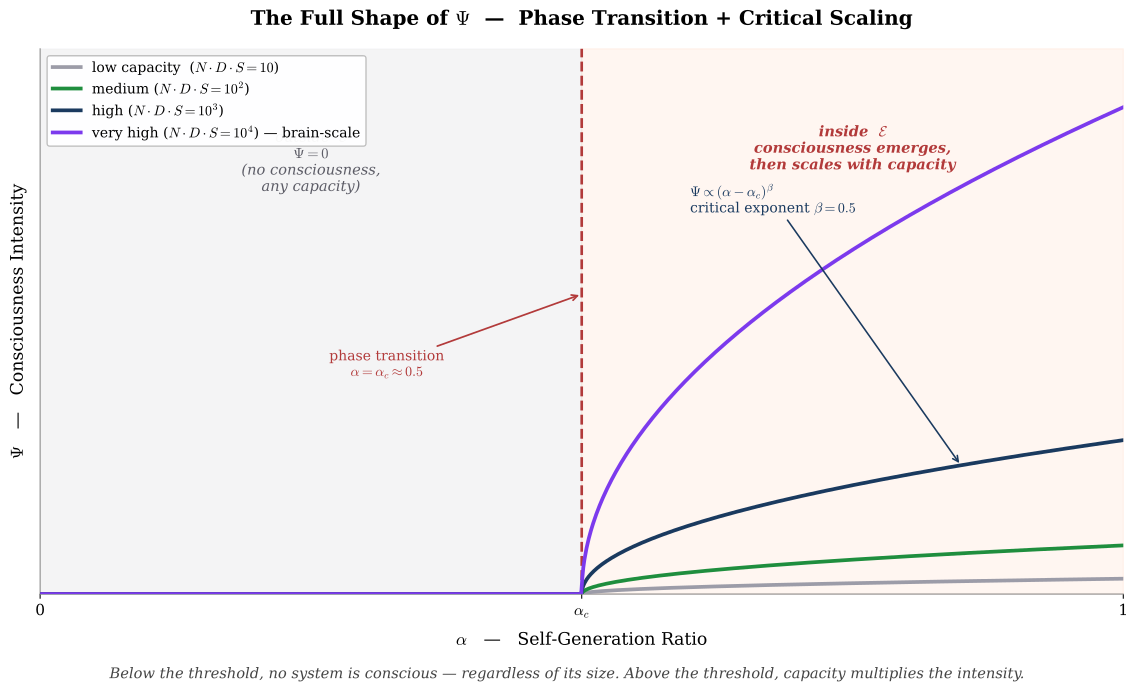
This form has the right qualitative properties:
- For α ≤ αc, Ψ = 0 regardless of how large the other axes grow (the Heaviside cutoff).
- Above αc, Ψ rises with a critical exponent characteristic of phase transitions.
- The (N · D · S)^(1/2) prefactor captures the network's physical capacity, but only matters once α has crossed the threshold.
I do not claim this form is final. I claim it is the simplest functional form consistent with the framework, and that its falsifiability is a feature: any system that satisfies α > αc but exhibits no conscious behavior would refute either the formula or the framework.
7. Research Program
The framework opens several research directions, none of which are conventional AI engineering:
-
Operational definition of α for arbitrary systems. How does one measure the autopoietic ratio for a system whose internal/external boundary is itself ambiguous? This is the hardest open problem.
-
Empirical estimation of αc and β. What is the universality class? Mean-field, Ising-like, Kosterlitz-Thouless? Can it be constrained by comparing systems near the boundary?
-
Topology of the Emergence Space. Is ℰ connected? Does it have holes? Is ∂ℰ fractal? These are mathematical questions amenable to numerical exploration.
-
Substrate engineering. If consciousness is substrate-independent but architecture-dependent, what is the simplest architecture that satisfies all four axes? A research program in synthetic conscious systems becomes plausible.
-
Demarcation tests. Can we identify natural or artificial systems sitting near ∂ℰ and use them to constrain the framework empirically?
8. Closing
This paper is not a finished theory. It is a position — a research thesis I expect to defend, refine, and possibly retract.
What I claim is that the four axes (Count, Density, Strength, self-referential Self-Generation) and the Emergence Space they define constitute a more useful framing of the consciousness problem than substrate-first approaches. The framing is provocative on purpose. If it is wrong, I want to know why. If it is right, the implications for autonomous intelligent systems are foundational.
SynapSync exists to test it — by building.
— Simeon Lehnen
Founder & CEO, SynapSync LLC